
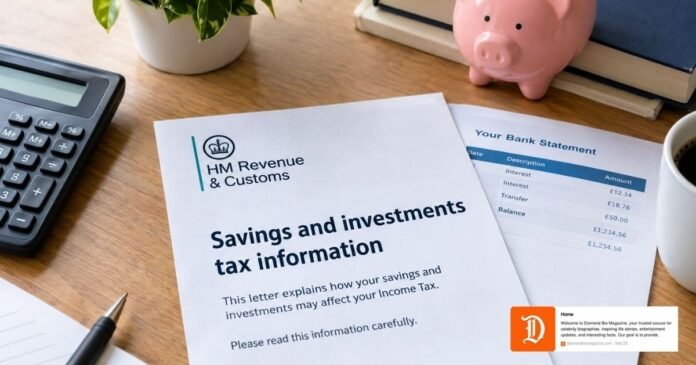

It can be worrying to receive a savings tax letter from HMRC, especially if you had not expected any communication regarding your savings or Income Tax. Yet the fact that you have received a letter from HM Revenue and Customs does not mean that you have done anything wrong or that there is a big tax bill awaiting you.
In numerous instances HMRC dispatches these letters since it has obtained information concerning the interest earned on savings accounts and needs to clarify the way in which that income influences your tax situation. The banks and building societies usually furnish HMRC with details of the interest which they have paid on the accounts, enabling the tax authority to verify that the appropriate amount of tax has been taken into account.
The letter could be giving reasons for a change to your tax code, provide details about savings interest, or inform you that extra tax may be due. You should therefore take the time to read the information rather than disregard it.
The reason why you have received an HMRC savings tax letter, together with details about how interest on savings is taxed and what you should check, will make the whole process a lot less confusing.
Why HMRC Sends a Savings Tax Letter
HMRC is given details regarding the interest paid by banks and building societies. It is possible to use this information to verify whether your Income Tax situation takes into account the interest you have earned over the tax year.
Savings interest is usually considered to be taxable income, though in many cases people are able to get some interest free of tax because of the allowances that apply in their particular situations.
If HMRC thinks that your savings interest has had an impact on your tax situation it might send you a letter to explain its calculations; this letter could be about a previous tax year or it could be concerning an adjustment to your tax code.
A person who usually pays tax through PAYE might have their tax code altered by HMRC so that extra tax is taken from their salary or pension. In some other cases, however, HMRC may request that the taxpayer handles the amount separately.
An HMRC savings tax letter is usually just an information notice or one which adjusts the tax, not an indication of a serious problem.
How Savings Interest Can Affect Your Tax
The quantity of tax you have to pay on the interest from your savings will depend on your particular situation, such as your income and the kind of savings account you have.
The Personal Savings Allowance enables a large number of taxpayers to have a particular amount of savings interest taxed at a rate of zero. The size of the allowance varies according to the taxpayer’s Income Tax band, larger allowances being available to basic-rate taxpayers than to higher-rate ones, while additional-rate taxpayers do not get a Personal Savings Allowance.
There are as well different rules applicable to certain kinds of savings and investments; for instance, the interest gained in an Individual Savings Account is usually dealt with in a different way from the interest earned in a normal savings account.
It means that two individuals who earn the same amount of bank interest won’t necessarily have the same tax liability.
HMRC could work out your position on the basis of information given by financial institutions. However, the figures that HMRC uses may not always correspond with what you expected if your income or savings situation has changed during the year.
It is important therefore to compare the figures in your HMRC savings tax letter with your own records.
What to Check on an HMRC Savings Tax Letter
On receiving the letter, first verify the basic details and ensure that your name, tax year and other personal information are correct.
Now, carefully examine the figures relating to the savings accounts and the interest amounts in question and compare them with the statements or annual interest summaries sent you by your banks and building societies.
You should focus on the tax year that the letter relates to, since savings interest may be reported after a tax year has ended and as a result the date on which HMRC writes to you may differ from the date on which you actually received the interest.
It’s also a good idea to verify whether an account has been closed, transferred or altered. When you have more than one savings account, you should take all of them into account when calculating the total interest.
If the figures are wrong, it doesn’t mean that HMRC is correct. Make sure you collect your bank statements and any other pertinent documents so that you can work out the actual interest that you received.
You ought also to read the instructions in the letter carefully, since some of the correspondence may not require you to take any action at once whereas other letters might tell you about a change to your tax code or request that you get in touch with HMRC.
What to Do If the Figures Are Wrong
Your HMRC savings tax letter sometimes includes information which does not agree with your records and this may be due to a number of factors such as changes to your accounts, having given HMRC incorrect information or there being a difference between the estimated and the actual figures.
If you think that something is in error, then check the figures provided by HMRC against the official statements from your bank or building society. Make sure you keep copies of the relevant documents and record the amounts and dates in question.
If the discrepancy still exists, you should get in touch with HMRC using the official contact details given on the letter or by visiting the GOV.UK website; state which of the two figures you think is wrong and make sure that your supporting information is ready.
Do not make any assumptions regarding how much tax you owe until you have established which of the figures is correct, and a discrepancy between your own calculation and that of HMRC does not necessarily indicate that either side has made a serious mistake.
It is just as important to make a distinction between interest on savings and other kinds of income since dividends, investment gains and some other payments are subject to different tax rules.
Where your finances are complicated, getting professional tax advice could be useful, especially if you have a large amount of savings, more than one source of income, or if there are several tax years concerned.
Understanding Tax Code Changes and Potential Payments
A very confusing aspect of an HMRC savings tax letter is if there is a change to your tax code.
If HMRC thinks that you have got taxable savings interest it might alter your PAYE tax code so as to collect extra tax from your future income. This could affect the amount of tax taken out of your salary or pension.
The fact that a change to the tax code doesn’t mean that you have to make an immediate payment directly to HMRC should be explained in the letter, together with the period it covers.
It is necessary to verify the calculation. If your situation has changed, the adjustment might have to be revised.
For instance, if there has been a substantial fall in the interest on your savings, an earlier estimate might no longer give an accurate picture of your present situation. In the same way, opening up a number of new interest-earning accounts can raise your taxable savings income.
It is much easier to deal with these situations if you keep your annual bank statements and interest records.
Conclusion
A letter from HMRC regarding savings tax is generally intended to ensure that interest on your savings has been taken into account when determining your Income Tax position. The fact that you have received such a letter does not necessarily mean that you have made an error or that you owe a large sum of money.
Check the tax year, the details of your savings accounts and the interest figures against your bank statements. If all the information appears to be correct, then follow the instructions given in the letter. But if there is any discrepancy, collect your evidence and get in touch with HMRC for clarification.
The best method is straightforward—look at the figures, understand the purpose of the letter and take action only in respect to the information that relates to your own situation.
FAQs
1. Why did I get a savings tax letter from HMRC?
You could have got the letter since HMRC has details regarding the interest earned on your savings and is therefore explaining the way in which that interest affects your Income Tax situation.
2. Does getting a savings tax letter from HMRC mean I owe tax?
It doesn’t have to; the letter could merely be setting out your tax position, relating to a tax code amendment or giving information about your savings interest which HMRC has obtained.
3. How is the savings interest that HMRC has used supposed to be checked?
Check the figures given in the letter against your annual interest statements or other records provided by your banks and building societies.
What constitutes the Personal Savings Allowance?
The Personal Savings Allowance means that if you’re eligible, you can earn a certain amount of interest on your savings without paying any tax on it. How much you can earn tax-free depends on your Income Tax situation.
5. Can changes to the interest on savings affect my tax situation?
Yes, if you have savings interest that is taxable and that affects your PAYE position, HMRC may alter your tax code so that tax is taken off your salary or pension.
What are the steps I should take if the figures in the letter are wrong?
Start with looking at your bank statements . If the figures are still wrong then you should contact HMRC through their official contact details and provide them with the relevant evidence .
7. Is the interest received from an ISA handled in the same way as interest from ordinary savings?
ISAs have special tax rules and interest earned in a tax-free ISA is usually treated differently to interest earned in a normal taxable savings account.
8. Should I disregard the letter if I do not consider that I have a tax liability?
Of course. Read the letter carefully and check whether HMRC requires any action on it. If you think the information is wrong then deal with the matter rather than ignoring the communication.