
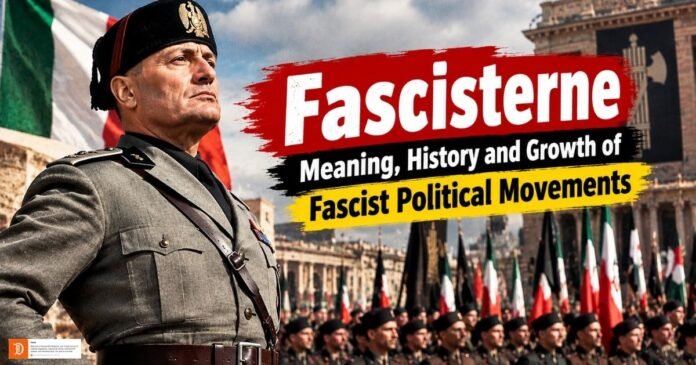

Political terms usually have a deeper meaning than their literal translation would seem to suggest. The word “Fascisterne,” for example, connects language to a significant chapter in European political history. Fascisterne in Danish is translated into English as “the fascists” and refers to people who hold fascist political beliefs or are members of fascist political movements. The term is not the name of a political party per se, although it may be used when referring to certain groups in a historical context.
We need to look beyond its translation to understand Fascisterne. Fascism was a political movement that began in Europe in the early 20th century. This was a time of economic uncertainty, social unrest, strident nationalism and dissatisfaction with democratic institutions. Fascism developed differently in each country but was shaped by leaders such as Italy’s Benito Mussolini and Germany’s Adolf Hitler in the movement’s history.
Today the word has still been used in historical research, in political discussions, and in debates on democracy and individual rights. By examining the language of politics, its history, its characteristics, and how it is used today, readers will better understand how political language reflects larger events and ideas.
What Does Fascisterne Mean in Danish?
Most directly translated into English, fascisterne means “the fascists.” It is the definite plural of the Danish noun fascist, which refers to a person in support of fascism. In Danish, this grammatical meaning is most often expressed by adding an ending to a noun rather than placing a separate word before it.
The related forms make it easier to understand the difference:
Fascist: A fascist.
Fascist: The fascist.
Fascists. Fascist.
Fascisterne. Fascisterne.
Fascism. Fascism, political ideology.
This difference is important when translating Danish historical documents, news reports or political commentary into English. Fascisme is the ideology, and the word Fascisterne is used to identify people.
It is not a word that automatically suggests a country, a political leader or an organization. For example, a Danish author writing about Italy in the 1920s could use it to describe the followers of Mussolini. In another context it might mean Danish Fascists or people connected with similar political movements in other parts of Europe.
The information identifying the group is contained in the surrounding sentence. The first step toward a correct interpretation of the term is to grasp this linguistic distinction.
The Historical Roots of Fascism in Europe
Fascism became a force in European politics after the First World War. The war had inflicted huge casualties, economic dislocation and political chaos. Unemployment, social tensions and disputes about how governments should respond to these challenges afflicted many countries.
Such circumstances created opportunities for movements that could provide national regeneration, strong leadership and resolute political action. Fascist organizations offered themselves as an alternative to existing democratic systems, often using patriotic messaging, mass rallies, propaganda and intimidation to win supporters.
The movement’s early development was centered on Italy. Benito Mussolini founded a political movement based on fascism in 1919, and then founded the National Fascist Party. In October 1922, after the March on Rome, Mussolini became prime minister. In the years that followed, his government dismantled democratic checks and created a dictatorship.
Another major development in Germany occurred in 1933 with the rise to power of Adolf Hitler and the Nazi Party. Important features were common to Nazi Germany and Italian Fascism. These were authoritarian leadership, extreme nationalism and the suppression of political opposition. But Nazism was also particularly centrally focused on race ideology and antisemitism.
The Second World War demonstrated the horrible results of Nazi rule, including the Holocaust and other widespread destruction in Europe. This is one of the reasons why one often encounters Fascisterne when reading about dictatorship, political persecution and the fall of democratic freedoms.
Main Features of Fascist Political Movements
Fascist movements were different in different countries, but historians have identified some common elements. The identification of these features helps to explain what distinguished fascism from other political ideologies in the twentieth century.
Authoritarian leadership: Fascist governments concentrated political power in a strong leader and undermined institutions that could check that leader’s power. Often independent political parties, opposition groups and democratic checks were trampled underfoot.
Extreme nationalism: Fascist movements created a sense of nationalism whereby the nation was more important than the individual. Their idea of belonging to the nation may be one that excludes minorities or groups that are cast as outsiders or threats.
Suppression of opposition: Fascist regimes persecuted or suppressed independent newspapers, political opponents, trade unions and civil society organizations. In some cases governments resorted to imprisonment, violence and intimidation to silence criticism.
Propaganda and Political Mobilization : Fascist leaders used mass communication such as speeches newspapers posters rallies and other forms to communicate their messages to the public . The leader was often shown in propaganda as the embodiment of the nation’s strength, with opponents cast as the enemy.
Militarism and Political Violence : Fascist movements also tended to glorify the military and saw violence as a legitimate means to achieve political ends. Some became paramilitary organizations that intimidated opponents and engaged in street violence.
These features give a historical context to the term Fascisterne. But the label should not be casually tossed around. A meaningful historical assessment would examine the beliefs, actions, political organization of a movement and its relationship with democratic institutions, not a single accusation or slogan.
Fascism in Denmark and Its Historical Background
In the years before and during the Second World War there was also fascist and Nazi political activity in Denmark. One of the best known was the National Socialist Workers’ Party of Denmark, normally shortened to DNSAP.
Founded in 1930, DNSAP was heavily influenced by the Nazi Party of Germany. It drew from Nazi political ideology; anti-Semitism, authoritarian nationalism and hostility to parliamentary democracy were among its elements.
Despite the similarities, however, the Danish organization failed to gather broad electoral support. In the 1939 general election it gained around 1.8 per cent of the vote and won three parliamentary seats. These results show the difference between the political ambitions of a fascist organization and its real level of support.
From April 1940 to May 1945 Denmark was occupied by Germany. Danish political life in this period was dominated by occupation, resistance, collaboration and difficult questions about national independence. The DNSAP was looking for more influence during the occupation, but it was not the ruling party of Denmark.
Historically, one can understand fascisterne as referring to Danish fascists or other groups associated with fascist politics. But this should not be confused with another name for DNSAP itself. The first is a general Danish word, the second a specific political organization.
This is a useful distinction for researchers of Danish history, historians of translation, and interested in the ways in which fascist movements developed differently throughout Europe.
Fascisterne in Current Usage and Meaning
Fascisterne can today occur in history writing, Danish-language news media, political debate and online material. The meaning depends on the context where it is used.
In an academic paper the word can refer to a clearly identifiable historical group. In a news story, it may mean members or sympathizers of a particular movement. In political debate the term may also be used more loosely as a pejorative to people who are seen as authoritarian or aggressively nationalist.
These uses are not necessarily the same. It’s a serious political charge to call someone a fascist, and whether it’s right or wrong depends on the facts. Strong government authority in and of itself does not mean a political movement is fascist. A more careful analysis looks at its ideology, its attitude toward democratic institutions, its treatment of minorities and its use of political violence.
Also, the historical record shows why language must be precise. Fascism was not just a matter of liking national pride or strong leadership. Its historical forms have sought to subordinate individual rights to an exclusionary national project, to undermine democratic government, and to suppress perceived enemies.
To understand the Fascisterne, then, is a matter of translation and historical awareness for students, researchers, and general readers. It’s helpful to know what the word means, but a better understanding comes from recognizing the situations in which it is used.
Conclusion
Fascisterne is a Danish word meaning “the fascists”, and its importance is closely linked to the history of fascist movements in Europe. The word conjures up a complicated history of authoritarian politics, nationalism and threats to democratic freedom, from the rise of Mussolini in Italy to the Nazi regime in Germany and the activities of Danish fascist organizations.
To understand Fascisterne one has to distinguish between the grammatical meaning of the word, and the ideology it describes.
What Does Fascisterne Mean? Why Does Context Matter?
What does it mean exactly? Context matters. Well, the historical meaning of fascism should be judged on documented beliefs and actions.
It’s more than just a translation to learn the term. It underpins a good understanding of European history, an ability to interpret political language and the importance of democratic institutions and individual rights.
Also read: Troozer.com: Website Review, Features, Safety online and What Users Need to Know
Frequently Asked Questions
What Is the English Translation of Fascisterne?
Fascisterne is a Danish word meaning “the fascists.” It is a specific or identifiable group of people linked with fascism.
Is Fascisterne a Political Party?
Nope. Fascisterne is a generic Danish noun form, not the formal name of a specific party. The context within which the organization is being discussed.
What Is the Difference Between Fascism and Fascisterne?
Fascisterne means the fascists, a name for people. Fascism. The political ideology of authoritarian leadership, extreme nationalism, and suppression of democratic opposition.
When Did Fascism Start in Europe?
Fascism developed out of an organized political movement in Italy in the years after the First World War. Mussolini founded his movement in 1919 and became prime minister in 1922.
Who Were the Most Important Historical Fascist Leaders?
The major European fascist regimes were led by two very different men, Benito Mussolini in Italy and Adolf Hitler in Germany. Although their governments had authoritarian and nationalist traits in common, their ideologies differed.
Did Denmark Have a Fascist Movement?
Yeah. In Denmark there were fascist and Nazi political organizations, such as DNSAP, formed in 1930. The party failed to become the governing party in Denmark and only won limited electoral support.
Why Does Fascisterne Still Matter Today?
You see the word in historical research, in political commentary and in discussions about authoritarianism. By comprehending its meaning, readers will be able to more carefully assess political language and to distinguish between historical evidence and loosely applied labels.
How Do You Use Fascisterne in Writing?
If you are talking about a relevant group described as fascist in a Danish context, use Fascisterne. Identify the country, movement or historical period as far as possible. Give reliable evidence for political classifications.