

Open a greenhouse kit and you’ll probably recognise the door rails and glazing panels straight away. The narrow metal pieces can be harder to place. One may look like spare trim until the assembly drawing shows it joining two sections of the frame. In a timber roof, a diagonal board can be just as easy to overlook. Both pieces help limit movement that the rest of the frame would otherwise have to absorb.
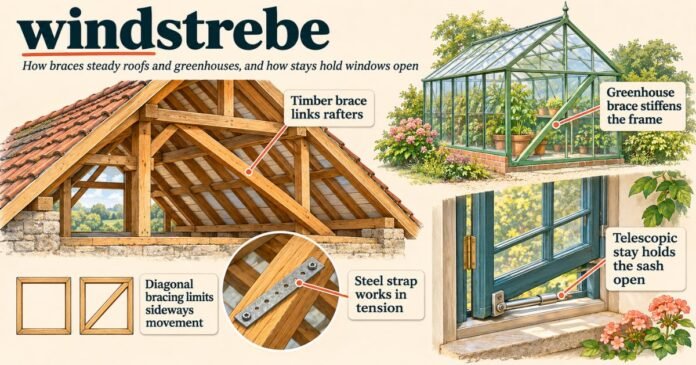
A windstrebe is the German term for a wind brace in construction. Its role is to help a frame hold its shape when wind pushes against it. The same word sometimes appears in window hardware listings, where it describes an arm that holds an opening window in position.
The easiest way to understand the difference is to look at what the part connects. A roof brace links parts of the timber frame. A greenhouse brace joins sections of a kit. A window stay connects the fixed frame to the part that opens. Those attachment points tell you more than the name alone.
How a windstrebe keeps a frame in shape
Picture a rectangle made from four strips of wood joined loosely at the corners. Push the top edge sideways and the rectangle starts to lean. Each strip can stay the same length while the corners change angle. Builders call this sideways distortion racking.
Now picture a rigid strip running from one corner to the opposite corner. It divides the rectangle into two triangles. For the frame to lean as it did before, the diagonal or its connections would have to move or deform. That’s the basic idea behind diagonal bracing.
You can often see this principle in an open timber carport. Look where a post meets the beam above it. A short angled piece can help stiffen that corner, while other braces may run across a wider section of the structure. The size and position can vary because each brace works with the surrounding frame and the joints that connect it.
Timber roof braces and steel straps
In a timber roof, a brace can link several rafters across the slope. The rafters form the shape of the roof, while the bracing helps control movement across the roof framing. When wind acts on the building, the forces pass through a series of connected parts. The brace forms one part of that route, so its end connections matter as much as its position on the drawing.
A solid timber brace may carry a pulling force, a pushing force or both, depending on how it’s designed and connected. A steel bracing strap works in tension, which means it carries force when pulled along its length. In German product listings, you’ll often see this flat metal strip called a Windrispenband.
Some roofs use two tension-only diagonals arranged in an X. When the frame tends to move one way, one diagonal takes the pull. When the force reverses, the other takes over. On a drawing, a timber brace and a steel strap may both appear as a diagonal line. The material notes and connection details tell you which component the design calls for.
Greenhouse braces and the fit of the glazing
A windstrebe in a greenhouse kit may be a slim profile that looks much like the pieces beside it. One of the easiest ways to identify it is to match the part number and fixing holes to the assembly drawing. Kits can list braces, roof stiffeners and glazing supports separately, even when the profiles look similar on the ground.
A square greenhouse frame makes a practical difference when you fit the glazing. If a corner has shifted, a correctly sized panel may be awkward to seat. Check the assembly sequence for your model. It will show when to check the frame alignment, tighten the fasteners and fit the panels.
If you need a replacement, note the greenhouse model and size before searching for the part. Two profiles can look alike in a product photo while having different lengths or fixing points. The part number in the manual gives you a better match than appearance alone.
Telescopic stays for windows and vents
In a hardware listing, a windstrebe can refer to a telescopic window stay. One end attaches to the fixed frame and the other to the sash, the part of the window that moves. As the sash swings open, the arm extends. Some models use adjustable friction to hold the sash at the opening you choose, which is handy when you want to air a room with the window slightly open.
When replacing a stay, check which way the sash opens, how far it needs to move and how much room the fitting has when the window closes. An inward-opening window and an outward-opening one can need different mounting arrangements. The product drawing is especially useful when the frame is narrow or there’s a blind or insect screen nearby.
Conclusion
A windstrebe helps a roof or greenhouse frame resist movement. In a roof, the brace may be a solid timber member or a steel strap that works in tension. In a greenhouse kit, it’s a specific frame component with its own mounting points.
On a window, the term can describe an adjustable arm that holds the sash at a chosen opening. If you’re trying to identify or replace any of these parts, start by tracing both ends. Then use the roof drawing, kit manual or hardware specification to match the part to its job.
FAQs
What does windstrebe mean in English?
Wind brace is the usual translation in construction. For a fitting that holds an open window in position, use window stay.
Is every wind brace visible from inside the building?
No. Some braces are visible in exposed frames, such as carports. Others can be concealed by roof finishes or fitted across the upper faces of rafters.
Why does a steel bracing strap have holes?
The holes provide fixing points for the fasteners specified for that strap and connection. The product instructions show which fasteners and fixing pattern to use.
Can a greenhouse brace fit a different model?
Compatibility depends on the length, profile shape and fixing points. Use the manufacturer’s part number or compatibility information to check the match.
Can a window stay hold a window partly open?
Many friction stays can hold a sash at several positions within their opening range. Check the fitting instructions for its range and any limits on use in windy conditions.