
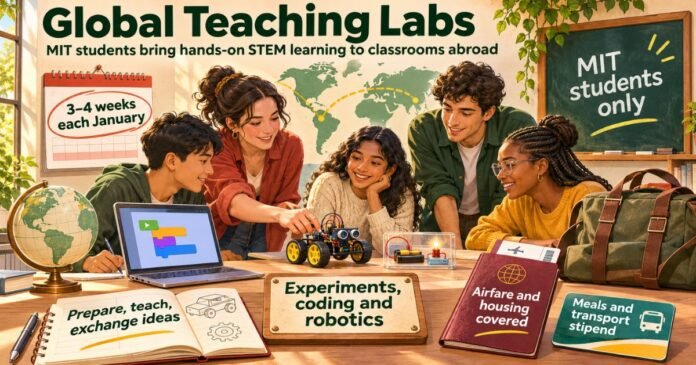

Understanding a scientific idea is one achievement. Helping a classroom full of students understand it is another. Add a different country, unfamiliar school routines and a new cultural setting, and teaching becomes a learning experience for everyone involved. That exchange sits at the heart of Global Teaching Labs, MIT’s international programme connecting student instructors with classrooms overseas.
Organised through the MIT International Science and Technology Initiatives, better known as MISTI, the programme takes place mainly during January. Participating MIT students spend three to four weeks teaching at partner high schools and universities during the Institute’s Independent Activities Period, or IAP.
Their work brings practical activities, experiments and fresh perspectives into subjects such as mathematics, physics, chemistry and computer science. Along the way, the visiting instructors develop their own ability to communicate, prepare lessons and respond to different learning needs.
For anyone interested in the programme, its appeal is easy to understand. It combines teaching abroad with cultural exchange and practical responsibility. However, eligibility, classroom arrangements and accommodation vary between destinations, making the details of each placement especially important.
How Global Teaching Labs Turns Knowledge into Practical Lessons
The programme reflects MIT’s emphasis on connecting intellectual understanding with practical work. Participants help students explore ideas through activities that encourage them to observe, test, build and explain.
That approach gives hands-on STEM education a clear purpose. A demonstration should do more than attract attention. It should help students understand something they can discuss, apply or investigate further.
For example, a beginner programming workshop might involve creating a simple interactive project. Students would break the task into manageable steps, test their code and correct errors. This illustrates the teaching method, although the actual activities depend on the school and assignment.
Courses commonly cover physics, chemistry, biology, mathematics, computer science and robotics. Certain placements also offer entrepreneurship, debate or other subjects requested by partner institutions.
The classroom format changes with the destination. In Mexico, most participants are paired with a local teacher, and some schools ask them to develop classes or workshops. Opportunities can involve both high school and university students.
Italy offers another model. Participants teach individually under a host teacher’s supervision at public high schools, often in smaller towns. Teaching takes place in English, with a schedule of up to 20 classroom hours per week.
That figure applies to Italy’s programme rather than every destination. Other placements may have different teaching hours, teamwork arrangements and preparation expectations.
Successful lessons also need to match the audience. A university workshop can assume a different level of knowledge from an introductory school activity. Instructors must consider what students already understand, what they should learn next and how an activity will help them get there.
Eligibility and the Preparation Required Before Departure
Global Teaching Labs is designed for MIT students. It offers opportunities for undergraduates and graduate students, subject to the requirements of individual country programmes.
The general academic threshold is a minimum GPA of 4.0 on MIT’s 5.0 scale. Applicants must submit a MISTI application and complete an interview. Selected participants are also required to attend five or six training sessions during the fall.
Academic performance provides part of the picture. Teaching involves explaining ideas clearly, listening to learners and recognising when an explanation needs adjusting. Working overseas adds the need to respect local expectations and cooperate with people whose classroom experience may differ from your own.
Applicants can prepare by thinking through a realistic lesson. Someone interested in teaching mathematics, for instance, could identify a concept, propose a short activity and explain how they would support students who needed extra help.
Previous tutoring, mentoring or classroom experience can provide useful evidence of those abilities. However, requirements vary. Some placements value an interest in education, while others specifically request teaching experience.
First-year applicants face additional restrictions and can apply only for listed countries and subjects. Graduate students should also review destination guidance carefully. Italy, for example, currently considers graduate applicants only if they completed their undergraduate studies at MIT.
Language expectations deserve the same attention. Mexico prefers Spanish knowledge without making it a general requirement for its teaching programme. Italy conducts teaching in English while giving preference to applicants with some knowledge of Italian.
Preparation continues outside the formal training sessions. The Eurasia programme expects participants to develop workshops before departure and coordinate with host teachers. Daily preparation also remains part of the work once teaching begins.
For students considering international teaching experience, this is an important practical detail. The commitment includes the planning that makes classroom time useful.
Funding, Cultural Exchange and Choosing a Placement
Global Teaching Labs is designed to be cost-neutral for participating MIT students. Essential expenses include airfare and housing, with a small stipend for meals and transportation.
Funding comes from MISTI donors, host institutions or a combination of both. The precise arrangements depend on the destination, so participants should understand how their own travel, accommodation and living expenses will be handled.
Housing can be an important part of the cultural experience. Italy uses host-family accommodation. In Mexico, arrangements may include host families, shared apartments or school residences.
Living with a local household can introduce participants to everyday routines, food and conversation beyond the school day. Shared accommodation creates a different experience, particularly when students are living with other visiting instructors.
Neither arrangement suits everyone equally. Practical needs, dietary requirements and comfort with shared living should all be considered when comparing placements.
The programme’s destinations span Africa, Asia, Europe and Latin America. Published opportunities for January 2027 include Ghana, Rwanda, India, Kazakhstan, Spain, Wales and Mexico, among others.
Each location has its own subject needs and available places. A country appearing on the destination list does not mean that every applicant is eligible for every assignment there.
For the January 2027 cycle, applications opened on 2 September 2026. The priority deadline was 21 September, followed by the final deadline on 23 September. Those deadlines have passed as of November 2026. Students planning for a later cycle should check its newly announced schedule.
Applicants can indicate first and second country preferences and express interest in other destinations. A useful comparison should consider the subject level, teaching format, language expectations, accommodation and preparation involved.
The strongest placement choice connects personal interests with a clear contribution to the host classroom. Confidence in explaining introductory coding, for example, may be especially useful in a beginner workshop. Choosing an assignment that matches existing strengths gives participants a practical foundation for developing their teaching skills.
The wider value of Global Teaching Labs comes from this shared experience. Host students encounter another approach to learning, while visiting instructors discover how much thought goes into making knowledge accessible.
Conclusion
Global Teaching Labs combines practical STEM teaching, cultural exchange and careful preparation within a short overseas placement. Its funding supports participation, while destination requirements shape who can apply and what they will teach. For eligible MIT students, the best starting point is to identify a subject they can explain well and find an assignment where that knowledge meets a classroom’s needs.
FAQs
Who can apply to Global Teaching Labs?
The MIT programme is open to eligible MIT students. Undergraduate and graduate opportunities depend on the destination, with additional restrictions for first-year applicants.
How long does the programme last?
Placements generally last three to four weeks in January during MIT’s Independent Activities Period. Exact teaching and travel dates vary by destination.
What expenses does the programme cover?
Essential expenses include airfare and housing, along with a small stipend for meals and transportation. Participants should confirm the arrangements for their placement.
Is previous teaching experience necessary?
It depends on the assignment. Teaching experience can strengthen an application, and some placements require it, but it is not a universal entry condition.
Do participants need to speak the local language?
Language expectations vary between countries and schools. Some placements teach in English while preferring applicants with local-language knowledge.
Can applicants choose their destination?
Applicants can state country preferences, but a preferred destination is not guaranteed. Placement depends on eligibility, selection and available opportunities.