
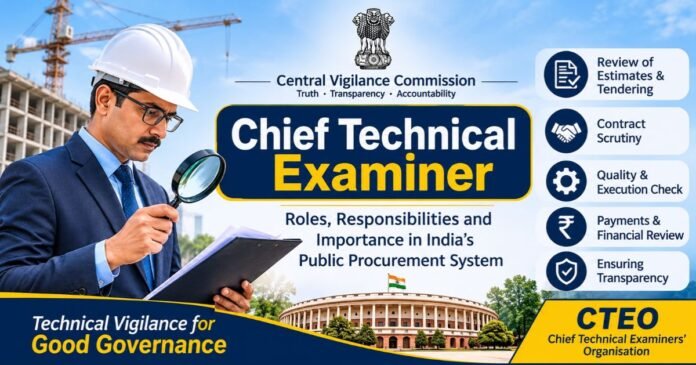

The proper use of public money depends on more than approving budgets and awarding government contracts. Every project must follow the right procedures, meet technical standards, maintain accurate records and deliver the value promised. In India, the Chief Technical Examiner plays an important role in this process by bringing technical expertise into the country’s public procurement and vigilance system.
Associated with the Chief Technical Examiners’ Organisation (CTEO), the position focuses on examining selected government projects, contracts and procurement activities. Its work can involve construction, engineering, material purchases, equipment supplies and other public-sector assignments. Rather than concentrating only on whether a project has been completed, technical examination looks at how the work was planned, tendered, executed, measured and paid for.
This function is particularly important when government organisations manage large contracts involving substantial public expenditure. A careful scrutiny can reveal weaknesses in estimates, unfair tender conditions, poor quality materials, wrong measurements or payments not corresponding to actual work.
Knowing this role helps engineers, contractors, procurement professionals and government employees understand how technical scrutiny supports transparency, efficiency and accountability.
What Is a Chief Technical Examiner and How Does the Organisation Work?
A Chief Technical Examiner is a senior technical official associated with the Chief Technical Examiners’ Organisation, the technical examination wing of India’s Central Vigilance Commission (CVC).
The organisation provides specialist scrutiny of selected government procurement cases and works. Its purpose is to examine whether public contracts have been handled properly from technical, contractual, financial and procedural perspectives.
The distinction between technical examination and project management is important. A project engineer generally supervises the design or execution of a particular assignment. The procurement officer is responsible for the purchasing or tendering process and the internal audit team may be concerned with financial controls.The CTEO examination brings these different aspects together to see if the whole contracting process can withstand scrutiny.
The organisation’s work can include reviewing:
- Project estimates and technical approvals.
- Tender documents and bid evaluation.
- Contract agreements and approved specifications.
- Material inspection and acceptance records.
- Measurement books and site documentation.
- Contractor bills, payments and variations.
- Physical progress and quality of completed work.
The CTE and CTEO are related but different terms. CTE refers to the Chief Technical Examiner, while CTEO refers to the organisation responsible for carrying out technical examinations. The CVC provides the wider vigilance framework within which this work takes place.
Historical Background of CTEO
The Chief Technical Examiners’ Organisation was established in 1957 under the Ministry of Works, Housing and Supply. Its original responsibility was to conduct technical audits of Central Public Works Department projects and improve economy, efficiency and control over government expenditure.
The Santhanam Committee, which examined measures to prevent corruption, recommended strengthening the organisation and extending its technical examination activities to construction projects handled by other government departments.
In 1964, CTEO came under the administrative control of the Central Vigilance Commission. A second Chief Technical Examiner position was subsequently created in 1979 as government procurement activities increased.
Over time, the organisation’s responsibilities developed beyond traditional construction projects. Its examination framework now covers a wider range of procurement and contractual activities.
Major Roles and Responsibilities of a Chief Technical Examiner
The work of a Chief Technical Examiner involves several connected responsibilities. The central objective is to establish whether government contracts are properly planned, fairly awarded and correctly executed.
Reviewing Estimates and Technical Approvals
A project estimate provides the financial and technical foundation for a government contract. If its quantities, specifications or rates are inaccurate, the problem can affect the entire procurement process.
Technical examination may assess whether estimates are reasonable, whether the selected specifications meet project requirements and whether the necessary approvals were obtained before work began.
The review can also identify unsupported cost assumptions, unnecessary quantities and unjustified changes to approved plans.
Examining Tender Procedures
Fair competition is a major requirement of public procurement. The tender documents should provide clear conditions and a level playing field for eligible suppliers or contractors to compete.
Examination may include review of requirements for eligibility, technical specifications, statements of comparative bids, price evaluation and reasons for the final contract award.
Unnecessary restrictive conditions or inconsistent treatment of bidders may raise concerns, in particular where there is no reasonable technical explanation for it.
Contract Agreements and Execution Verification
Once a tender is awarded, the agreement outlines the responsibilities of the government organization and the successful contractor.
A technical review can compare the original contract with the actual execution of the project. This includes reviewing approved rates, contractual conditions, variations, additional work and changes in specifications.
The purpose is to establish whether decisions made during execution were properly authorised and supported by the contract.
Quality of Work and Materials Examination
Another important part of the process is physical inspection, especially in engineering and construction assignments.
An examination may be a comparison of actual site conditions with drawings, technical specifications, measurement records and quality-testing documents.Materials supplied under contract can also be verified against the standards and acceptance procedures required.
This allows you to identify any mismatches between the record of what is complete and what is actually on site.
Reviewing Bills and Payments
Payments must correspond to the work performed or materials supplied under the contract.
The examination can compare contractor’s bills with the measurement books, approved quantities, contractual rates, test results and supporting documents.
Discrepancies may indicate incorrect calculations, unsupported variations, excess payments or other financial irregularities.
CTEO Intensive Examination and Inspection Procedure
An Intensive Examination is a comprehensive examination of a specific government contract or procurement activity.This is not just a simple paper check, it combines technical, financial, contractual and, where necessary, physical site inspection.
The process generally involves several stages.
1. Selection of contracts: CTEO selects certain procurement cases for examination. Organisations submit Quarterly Progress Reports, which help the technical examination organisation identify suitable contracts based on prescribed parameters.
2. Document review: The examination team studies estimates, technical sanctions, tender records, agreements, drawings, measurement books, bills and other relevant documents.
3. Technical assessment: The team checks whether the work or supplies meet contractual specifications and whether the recorded quantities and quality are supported by evidence.
4. Physical inspection: Depending on the case, an inspection may be conducted to compare site conditions with official records and approved requirements.
5. Preparation of observations: Findings are documented in an examination report. These may relate to procurement procedures, quality, measurements, financial implications or contractual deviations.
6. Follow-up action: The report is forwarded to the concerned organisation’s Chief Vigilance Officer (CVO) for comments and appropriate action.
It is important to understand that selection for an examination does not automatically mean that corruption or misconduct has occurred. A technical deviation may have a legitimate explanation. The examination establishes the facts and provides an opportunity for the concerned organisation to respond.
CTE vs CVO and the Importance of Technical Vigilance
The Chief Technical Examiner and Chief Vigilance Officer have different responsibilities, although their work can be connected during an examination and its follow-up.
AreaCTECVOMain responsibilityTechnical and contractual scrutinyOrganisational vigilancePrimary focusProcurement, quality, measurements and paymentsVigilance complaints, investigation and preventive measuresWorking areaSelected contracts and procurement casesVigilance activities within an organisationMain contributionIdentifying technical and procedural irregularitiesCoordinating follow-up and appropriate vigilance action
Since CTEO cannot directly examine every government contract, CVOs also conduct CTE-type Intensive Examinations within their respective organisations under the CVC framework.
Technical vigilance matters because problems in public procurement do not always appear as obvious financial discrepancies. An inflated estimate, poor-quality material, unfair tender condition or incorrect measurement can affect the value received by a government organisation.
The CVC’s 2024 Annual Report provides a useful indication of the scale of this work. It records 81 Intensive Examinations covering 64 organisations during the year, involving procurement cases with a combined value exceeding ₹33,514.68 crore. It also reports 1,845 CTE-type examinations by CVOs from 299 organisations.
The figures show the need for a systematic examination of procurement activities and not merely routine administrative checks.
Conclusion
The Chief Technical Examiner is a crucial functionary in the public procurement and vigilance system of India.The role, through technical assessments, contract reviews, physical inspections and financial scrutiny helps to identify weaknesses which could affect government expenditure and project quality.
Its functions are far more extensive than checking construction work.This covers the whole procurement process from preliminary estimates and tender conditions to contractual execution and final payments.
The CTEO framework provides a better understanding of public-sector accountability for engineers, contractors, government employees and procurement professionals.Ultimately, proper technical examination helps ensure that government contracts are awarded fairly, records are reliable and public funds are producing the intended results.
Frequently Asked Questions
1. What is the full form of CTE?
CTE stands for Chief Technical Examiner. It is associated with the Chief Technical Examiners’ Organisation (CTEO), which conducts technical examinations under the CVC framework.
2. Is the Chief Technical Examiner part of the CVC?
Yes. The CTEO functions as the technical wing of the Central Vigilance Commission and came under its administrative control in 1964.
3. What does a Chief Technical Examiner inspect?
The examination may cover project estimates, tender documents, contracts, quality of materials, measurements, site records, contractor bills, payments and adherence to applicable procedures.
4. What is an Intensive Examination by CTEO?
It is a thorough examination of a government contract or procurement case chosen for document review, technical assessment, financial scrutiny and, if needed, physical inspection.
5. Does a CTE inspection automatically indicate corruption?
No. An inspection is meant to establish facts and find possible irregularities.Technical or procedural observations do not constitute proof of corrupt intent per se.
6. What is the difference between CTE and CVO?
The CTE focuses on technical and contractual examination, while the CVO coordinates vigilance activities within a government organisation, including follow-up on relevant examination observations.
7. Which government contracts can be examined by CTEO?
Depending on the nature of the assignment and the applicable framework, examinations can be on civil works, electrical and mechanical projects, supply contracts, equipment purchases, IT procurement and service-related contracts.