

Teeth whitening is one of the most enticing cosmetic services a dental practice can provide. Patients like the quick results, the procedure can be fitted into a regular appointment schedule and clinics can generate additional revenue without introducing a whole new treatment category. However, the equipment behind the service can create costs that are easy to overlook.
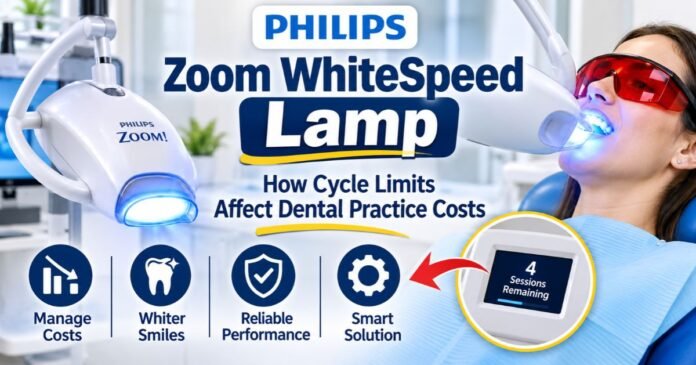
The Zoom WhiteSpeed Lamp is a popular professional whitening system, but its light guide has a limited number of treatment sessions. Once those sessions are used, the system displays a replacement message, requiring the practice to change the guide before continuing with another treatment. This creates an ongoing expense that can influence the overall profitability of in-office whitening.
Busy dental clinics don’t have a problem with the price of another component. Daily operations can also be affected by replacement orders, inventory management and unexpected interruptions. Understanding the cycle counter allows practice owners to make better purchasing decisions and to look more closely at alternative accessories.It also explains why you should factor equipment costs into the treatment pricing equation when developing a successful cosmetic dentistry service.
How the Zoom WhiteSpeed Lamp Cycle System Works
Philips Zoom WhiteSpeed uses LED technology to deliver professional light-accelerated teeth whitening. It is designed to work with compatible whitening gels and procedure kits under the supervision of trained dental professionals.
One important part is the lightguide. This attachment helps to maintain the accelerator head and patient’s smile area at the correct distance and alignment. It also contains an electronic system that records the available treatment sessions.
The manufacturer recommends that each new light guide be “activated” for four 15 minute sessions. Typically three sessions are needed, although a fourth may be added for patients with darker shades of teeth. The display shows how many sessions remain as the procedure progresses.
When all allocated sessions have been used the equipment will display a message that the light guide needs to be replaced. The replacement message is part of the system’s intended operation rather than necessarily indicating that the main LED lamp has stopped working.
This distinction matters for practice owners. The expense is connected to the light guide and its cycle allowance, not simply to the purchase of the original whitening machine.
Three Ways Cycle Limits Affect Dental Practice Costs
The cycle counter may appear to be a small technical feature, but it can influence several parts of a clinic’s business operations.
1. Repeated Replacement Expenses
The first and most obvious expense is the need to purchase replacement light guides.
A practice that provides whitening occasionally may not notice this cost immediately. However, clinics offering several whitening appointments every week can use their available sessions much faster.
These recurring purchases need to be included when calculating the actual cost of delivering each treatment. “If you’re only looking at the cost of the whitening gel, staff time and patient charges, you’re not seeing the whole financial picture.
For instance, a clinic should include the cost of the light guide in the treatment margins along with other consumables. Even relatively small recurring expenses can become significant when multiplied across a busy schedule.
2. Inventory Management and Appointment Interruptions
The second issue is operational disruption.
A dental team needs to know how many sessions remain before scheduling another whitening appointment. When the guide reaches its limit unexpectedly, the practice may have to arrange a replacement before continuing with the next patient.
This makes stock management particularly important for clinics with regular cosmetic appointments.
There is also a difference between an ordinary replacement and an interrupted session. Philips’ instructions explain that switching off the equipment, losing power or disconnecting the light guide during a session can cause the session to be lost. Staff are therefore instructed to use the pause function when appropriate rather than stopping the procedure incorrectly.
Keeping spare supplies available and training assistants on the correct operating procedure can help reduce avoidable disruption.
3. Pressure on Treatment Profit Margins
The third financial effect is the relationship between treatment volume and equipment expenses.
When whitening appointments increase, the practice uses its available light guide sessions more frequently. This means replacement supplies must be considered as part of the ongoing cost of providing the service.
The problem is not necessarily that whitening becomes unprofitable. Rather, owners may underestimate how much equipment-related spending affects the final margin.
A useful approach is to calculate the total supply cost for a complete whitening appointment and review it regularly. This provides a clearer understanding of which expenses are fixed, which increase with treatment volume and where operational improvements may be possible.
Third-Party Chips and Alternative Light Guide Options
Some dental practices investigate aftermarket accessories as a possible way to reduce repeated light guide purchases.
One product discussed in this area is Bleach Infiniter, developed and marketed by Orange Systems LLC. According to its website, the company offers a chip-equipped light guide designed to keep the Zoom system displaying available treatment sessions rather than following the original cycle limit.
The company also states that its product is compatible with selected Philips Zoom WhiteSpeed and earlier Zoom systems. These are manufacturer claims about its own product, not independent proof of compatibility or clinical performance.
There is an important distinction that buyers should understand. Bleach Infiniter identifies itself as an independent manufacturer and clearly states that Philips and the Zoom trademark owners are not affiliated with, sponsoring or endorsing its products.
That means a practice should not automatically assume that an aftermarket accessory has the same validation, service support or warranty position as an original Philips component.
Before considering this type of option, owners should check several points:
- Model compatibility: Confirm the exact WhiteSpeed version and light guide specification supported by the supplier.
- Warranty implications: Ask the Philips distributor or service provider whether using a third-party accessory affects equipment support or warranty coverage.
- Clinical suitability: Request documentation about optical performance, physical durability and the intended conditions of use.
- Hygiene requirements: Confirm whether repeated use of the guide is permitted and whether an appropriate cleaning and infection-control process is documented.
- Total purchase cost: Include shipping, taxes, installation arrangements, replacement terms and after-sales support.
These checks are especially important because the light guide is not merely an electronic counter. It also plays a role in maintaining the correct position and distance for light exposure.
Changing the number displayed on a screen does not, by itself, demonstrate that a component is suitable for unlimited clinical use.
Creating a More Predictable Whitening Workflow
A well-managed whitening service depends on more than the equipment itself. Staff training, reliable supplies, patient preparation and accurate financial planning all contribute to consistent daily operations.
Owners of dental practices might start by tracking how many whitening appointments they complete each month, and the costs of light guides, gels and other treatment supplies. This information makes it easier to identify changes in operating expenses.
And it is also useful to set up a stock-check routine. Assistants may check the residual guide sessions and replacement supplies available before the working day starts.This one simple habit will make it less likely that you’ll discover a shortage of supplies just prior to a scheduled appointment.
Owners should also consider the long term cost of maintaining the equipment when evaluating the Zoom WhiteSpeed Lamp. Original replacement guides, aftermarket alternatives and service requirements should be compared using documented specifications rather than advertising promises alone.
The objective should be to keep the whitening service financially manageable without compromising manufacturer instructions, patient protection or professional standards.
Conclusion
The Zoom WhiteSpeed Lamp can support a valuable cosmetic dentistry service, but its light guide cycle allowance introduces recurring expenses that practice owners should understand. Replacement purchases, inventory planning and treatment margins all deserve attention when calculating the true cost of in-office whitening.
Alternative accessories may look attractive, but compatibility, warranty conditions and clinical suitability have to be carefully verified before any purchasing decision.
In the end a profitable whitening service is a service with sensible operating costs, reliable equipment, trained staff and consistent patient care.
Frequently Asked Questions
1. What is the Zoom WhiteSpeed Lamp used for?
It’s a professional LED accelerator built to assist with Philips Zoom light-activated in-office teeth whitening procedures in dental practices.
2. How many sessions does a new WhiteSpeed light guide provide?
The manufacturer’s instructions state that each new light guide provides four 15-minute activation sessions.
3. Why does the system display Replace Guide?
This message comes up when all of the sessions assigned to the attached light guide are in use. The guide must be replaced according to the system’s instructions.
4. Does the cycle limit mean the entire whitening lamp has stopped working?
Not necessarily. The replacement message is related to the session allowance of the light guide. It does not automatically indicate a failure of the main LED accelerator.
5. What is Bleach Infiniter?
Bleach Infiniter is a third-party accessory marketed by Orange Systems LLC. Its manufacturer says the chip-equipped guide changes how the system reads available whitening sessions. It is not a Philips-endorsed product.
6. What should dentists check before purchasing an alternative light guide?
They need to consider model compatibility, clinical suitability, hygiene requirements, warranty issues, supplier dependability and the overall cost of ownership.
7. How can dental clinics control whitening equipment expenses?
Clinics can monitor supply costs/treatment, track remaining guide sessions, manage proper inventory and compare replacement options with validated technical data.