
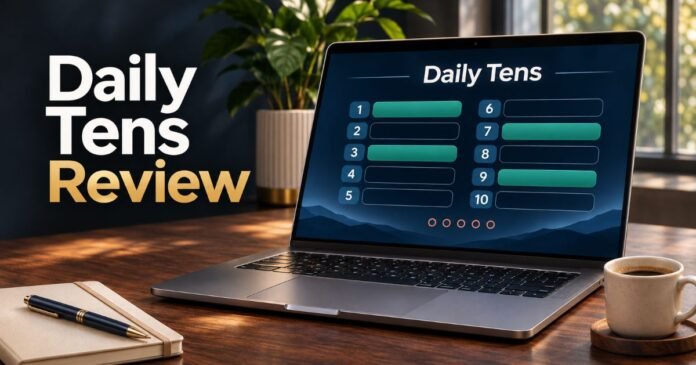

Remembering nine answers can feel more frustrating than remembering none. There’s one empty space left, a perfectly familiar name seems just out of reach, and every new possibility suddenly sounds convincing. Daily Tens builds its challenge around that moment.
Instead of asking you to select an answer from a list, this browser-based trivia game asks you to supply the list yourself. Each day brings a ranked top ten, and you have to identify its entries before five incorrect guesses end the round. The instructions are brief, but completing the board can take considerably more thought.
This Daily Tens Review looks at what makes that simple format engaging, where it can become frustrating and how to approach it without wasting guesses. It also clears up an important distinction between two similarly named websites whose features aren’t identical.
For anyone who enjoys a pub quiz, remembers unusual facts or likes having a small daily challenge, there’s an appealing idea here. The real test comes after the obvious answers: knowing enough to recognise a subject is different from knowing exactly which ten names belong on its list.
Daily Tens Review: A Straightforward Game With a Strict Cutoff
The basic rules are easy to follow. Read the day’s category, enter a possible answer and see whether it belongs in the ranking. A correct guess fills its place on the board. Your aim is to uncover all ten entries before making a fifth mistake.
The crucial detail is how the list is measured. On the .com website, an information icon explains the ranking metric. That might involve population, geographical area or box-office earnings.
Reading that explanation is part of playing well. A category about the biggest places could mean size or population, and the answers would change accordingly. A successful film might qualify under one revenue measure and miss out under another.
This is where the top-10 trivia format becomes interesting. Knowing that something belongs to a category isn’t enough. It has to meet the exact conditions of that particular list.
You don’t need to work out the ranking position yourself. Correct entries appear in their designated places, leaving you to concentrate on identifying the missing names.
The Appeal of an Almost-Complete List
The best part of the game is the change in pace as the board fills.
At first, you may have several answers ready. Those early successes make the task feel manageable. Then you reach the edge of what you can recall confidently, and each remaining space demands more attention.
An unfinished list gives your memory something concrete to work on. You can consider a different region, move through a timeline or think of names associated with an answer already on the board. Sometimes that brings back a fact you haven’t thought about in years.
For this Daily Tens Review, the strongest feature is that sense of progress. Even an unsuccessful attempt can leave you with a clear picture of what you knew and what escaped you.
The comparison with Wordle-style puzzles makes sense as a daily habit, although the thinking involved is different. Here, a strong vocabulary won’t carry you through an unfamiliar subject. The challenge depends much more on your store of general knowledge and your understanding of the category.
That makes it a natural fit for people who enjoy list quizzes and conversations that begin with a surprising statistic.
Similar Names, Different Websites
A useful Daily Tens Review needs to distinguish between the .com and .org websites rather than combine all their features into one description.
The .com game offers free browser play on phones and computers, with no download or compulsory account. It also has an archive of earlier lists. Optional Google sign-in allows players to sync progress and streaks across devices, while results include a percentile comparison with other players.
The .org website describes itself as an independent game with its own puzzles. It offers an archive, unlimited practice with past challenges and a hint system.
Its five hint steps are a shared allowance for the puzzle. A hint can progress from a clue to initial letters and then a revealed answer. Revealing one answer completely uses three steps.
Those details shouldn’t be assumed to apply to both websites. If you want hints or extended practice, check the rules of the site you choose. When playing alongside friends, make sure everyone is using the same website and challenge.
Where the Challenge Can Become Frustrating
The strict cutoff creates the game’s tension, but it can also be its biggest irritation.
An answer just outside the top ten still costs a mistake. Being close doesn’t earn partial credit. That can feel harsh when you understand the subject well but can’t remember the precise boundary.
Difficulty also depends heavily on the topic. A familiar category might produce a satisfying run of answers, while a specialist subject can leave you struggling almost immediately. Readers who want an evenly matched challenge every day may find that variation less enjoyable.
There’s also a difference between remembering a fact and remembering the right version of it. Rankings can change with time, and definitions matter. A list based on a particular year should be approached on those terms.
The .org website publishes information about its ranking methods, including data dates and source notes. Such explanations help players understand unexpected results, though each individual list still depends on the accuracy of its underlying information.
The fairest way to approach the game is to treat a missed answer as a prompt to learn something, rather than proof that your wider knowledge was useless.
Small Habits That Improve Your Guesses
Start by reading the category and metric slowly. Then enter the names you’re most confident about.
Once those are used up, organise your thoughts instead of trying unrelated possibilities. Work through regions for a geography category, periods for a historical list or relevant groups for a sports challenge.
Avoid treating fame as evidence of rank. A name that comes to mind quickly may be memorable without meeting the list’s requirements.
Finally, look back at the completed answers. Understanding one surprising inclusion can be more useful than rushing straight into another puzzle.
Conclusion: Worth Trying for Fans of List Quizzes
This Daily Tens Review comes down to a simple strength: the game turns a familiar trivia exercise into a focused challenge with meaningful limits. The ranked answers give it structure, while the mistake allowance makes uncertain guesses matter.
It will appeal most to curious players who enjoy recalling facts and can accept the occasional frustrating near miss. Read the ranking details, choose your website carefully and give the missing answers some thought. A good round can be satisfying even when the final space stays empty.
FAQs
Is Daily Tens free?
Yes. Both the .com and .org websites describe their games as free to play.
Do I need to install an app?
No. The game runs in a web browser, so a download isn’t required.
How many mistakes are allowed?
The round ends on your fifth incorrect guess. Finding all ten answers completes the challenge.
Do answers have to be entered in ranked order?
No. You can identify entries without guessing their positions; correct answers fill their places on the board.
Can I play older challenges?
Yes. Both websites provide archives, although you should check your chosen site for its current access conditions.
Are hints available?
The .org game provides five hint steps per puzzle. Features can differ between the two websites.