
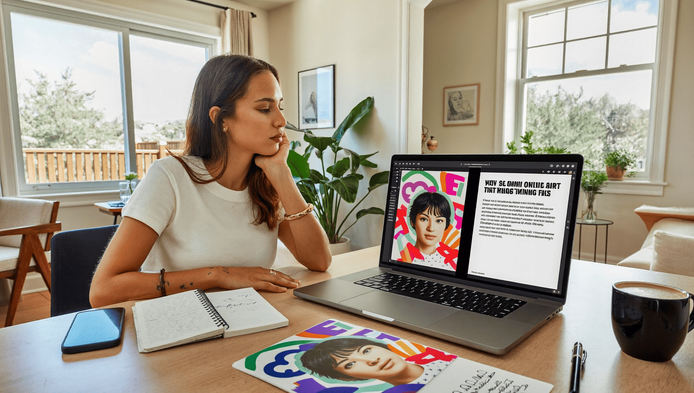

A slightly wrong tree is still a tree. A slightly wrong letter is not a letter.
That single difference explains almost everything about why text in generated images has been so persistently bad, and why it improved slowly while everything else improved quickly.
Image models learn visual patterns. A tree can vary enormously and still read correctly, because nobody is checking it against a specification. Letterforms have no such tolerance. The difference between an a and a badly drawn a is the difference between a word and a smudge, and the human eye detects it instantly.
Gemini Omni Flash, Google’s multimodal model, and the current generation of AI models handle short text considerably better than tools did two years ago. Higgsfield provides access to these advanced AI capabilities, but models can still fail in predictable places, and knowing where saves a great deal of time.
Why Is Text Fundamentally Different?
Because it is a symbolic system rather than a visual one.
Every other element in an image has tolerance. A chair can be any of ten thousand chairs. A face can vary and still be a face. Text has no tolerance at all, because each character is a specific agreed shape carrying a specific agreed meaning.
What that produces:
- Letters that nearly work, which read as wrong immediately
- Words with the right length and the wrong characters
- Plausible-looking strings that mean nothing
- Correct first letters degrading toward the end
- A Gemini Omni Flash output that is close and therefore worse than obviously wrong
The nearly-right quality is the specific failure mode. An image with obvious gibberish is clearly unfinished. An image with text that almost says something is published by somebody who did not look closely.
Read every word, not the shape of the word. That is the whole quality check and it takes seconds.
What Actually Works Now?
Short strings in simple arrangements, which covers more than people expect.
- Single words, reliably
- Short headlines, usually
- Simple signage, with few words
- Large text, where each character has room
- A Gemini Omni Flash prompt specifying exact wording, which helps considerably
What still fails:
- Paragraphs, which degrade quickly
- Small text within a layout
- Long strings of any kind
- Numbers, which are less reliable than letters
- Specific typefaces, since there is no real control
The paragraph case is worth stating plainly. Nothing currently generates a readable paragraph of text inside an image, and attempting it wastes an afternoon.
Specify the exact words you want in the prompt, in quotation marks. Models handle requested text considerably better than text they invent for themselves.
Why Are Non-Latin Scripts Worse?
Several reasons at once, and the gap is substantial.
Latin script has the most training data by a wide margin, and it is also among the simpler writing systems to render. Other scripts carry complications that compound the underlying problem.
- Chinese and Japanese have enormous character sets with fine distinctions
- Arabic uses contextual letterforms that change by position in a word
- Devanagari and related scripts use conjunct consonants that combine
- Thai and Khmer stack marks above and below the baseline
- A Gemini Omni Flash output in any of these needs checking by a reader of that script
The contextual forms problem is particularly difficult. An Arabic letter has different shapes depending on whether it starts, sits inside or ends a word, and a model producing letterforms in isolation produces something that is not quite writing.
Never publish text in a script you cannot read. Have somebody who reads it check it, every time, including the punctuation.
What Must Never Carry Generated Text?
Anything where the words have consequences.
- Never generate a logo containing text and use it
- Never generate a product label, including ingredients or warnings
- Never generate signage for a real place
- Never generate a document, certificate or official-looking record
- Never attribute a quote to anybody via a Gemini Omni Flash image
The label case has safety consequences. Ingredients, allergens, dosages and warnings are regulated information, and an approximation of them on a product image is a serious problem rather than a design error.
The document case is the one with legal weight. A generated certificate, invoice or official record is a forgery whatever it was intended for, and the intention stops mattering the moment it exists.
Type the words. It takes a minute and removes the entire category of problem.
Does This Change Anything About Design?
It returns typography to being a decision rather than an outcome.
Generated text removed control over the thing that carries most of a design’s tone. Separating the two gives it back, and the principles that always applied still do.
- Hierarchy, which no Gemini Omni Flash prompt establishes for you
- Contrast between text and whatever sits behind it
- Legibility at the size it will be seen, which is usually small
- Restraint, since two typefaces is almost always enough
- Appropriateness, which is a judgment no prompt makes
The contrast point matters most with generated backgrounds, because they tend to be busy. Text over a detailed image needs either a plain area, a shaded panel or an outline, and generated imagery rarely leaves a clean space unless asked.
Ask for space in the prompt. A composition with a deliberately plain upper third is considerably easier to work with.
What Is the Actual Workflow?
Generate the image without text, then add the text properly.
This is the answer and almost nobody states it directly. It is faster, it produces better results, and it solves every problem above simultaneously.
- Prompt for the image with space left where text will go
- Add the text in a layout tool, with a real typeface
- Control the kerning and spacing yourself
- Edit it later without regenerating anything
- Use Gemini Omni Flash for the imagery, not the lettering
The editing point alone justifies it. Text generated into an image is baked in. Text added over an image is a layer, which means a typo is a thirty second fix rather than a regeneration and a new round of checking.
It also gives you typeface control, which generation does not. If the typography matters, and the choice of font shapes how a message reads before anybody processes the words, then you need to choose the typeface rather than describe it and hope.
How Should Text Be Checked?
Character by character, at full size, by somebody who was not the person prompting.
- Read every word aloud, which catches what scanning misses
- Check at full size, since small previews hide errors
- Check numbers twice, as they fail more than letters
- Have somebody else look, because you see what you intended
- Check any Gemini Omni Flash output in a script you do not read with somebody who does
The fresh eyes point is genuine rather than procedural. Somebody who wrote the prompt reads the intended word rather than the rendered one, consistently, and misses errors that a stranger spots in a second.
Print it if it is going to print. Screen previews hide a great deal.
Does This Affect Localisation?
Considerably, and it is a strong argument for the separated workflow.
A campaign running in six languages needs the same image with six sets of text. Generated text means six separate generations, six sets of checking and six chances of error.
- One image, six text layers, produced once
- Consistent imagery across every market
- Translation handled by translators rather than by a model
- Text length differences accommodated in layout
- A single Gemini Omni Flash generation serving every version
The length variation is the practical issue nobody plans for. German runs considerably longer than English, and a layout built tightly around English text breaks when translated.
Leave room. It costs nothing at the design stage and solves a problem that is expensive later.
What About Accessibility?
Real text is readable by software. Text inside an image is not.
- Screen readers cannot read text that is part of an image
- Search engines index real text and not pictures of text
- Users cannot select, copy or translate it
- Scaling a text layer stays sharp; scaling an image does not
- A Gemini Omni Flash image with baked-in words serves nobody using assistive technology
This is why the web moved away from text-as-image two decades ago, and the reasoning has not changed.
Where text must be in an image, the alt text has to carry it. Where it does not need to be, keep it as real text and everything works better.
Does Handwriting Fail Differently?
It does, and it is worth knowing because handwriting is requested constantly.
Generated handwriting looks convincing at a glance because handwriting is expected to be irregular. That tolerance is exactly what makes it dangerous, since the eye forgives variation it would never accept in type.
Where it falls apart:
- Longer passages, which drift into shapes that are not letters
- Consistency, where the same letter is formed differently each time
- Joining, which cursive requires and models approximate
- Signatures, which should never be generated at all
- A Gemini Omni Flash handwriting sample read closely rather than glanced at
The signature point deserves emphasis. A generated signature is a forgery regardless of whose it resembles or what it was for, and there is no legitimate version of producing one.
For decorative handwriting, short is safe. A single handwritten word over an image generally works, and a handwritten paragraph generally does not.
Where the handwriting carries meaning, write it and photograph it. Ten seconds with a pen produces something no model matches, and it is unarguably yours.
How Should Files Be Kept?
With the image and the text separate, permanently.
- Keep the Gemini Omni Flash image without any text applied
- Keep the text layers as editable files
- Note the typeface and sizes used alongside the Higgsfield files
- Store the Higgsfield project for the imagery
- Keep the final flattened version alongside the source
The separation is what makes a campaign maintainable. A price change, a date change or a correction becomes a text edit rather than a regeneration.
Noting the typeface beside the Higgsfield project is the detail people skip and need within a month. Matching a font from memory is guesswork and takes longer than writing it down did.
What Would One Image Take?
Ten minutes, done the right way round.
- Prompt for imagery only, with space left for text
- Generate several options in Gemini Omni Flash
- Pick one with a usable clean area
- Add text in a layout tool, with a chosen typeface
- Check the contrast against the Higgsfield background and the legibility at final size
- Have somebody else read it
- Save the Higgsfield image and the text layers separately
Then look at it at the size it will actually appear, which is usually smaller than the screen you designed on.
Ten minutes is less than a single round of regenerating an image because one letter was wrong.
Conclusion
The reason text in images has lagged everything else is that writing is a system with rules, and image generation is pattern matching without them.
Gemini Omni Flash handles short text better than anything before it, and Higgsfield runs it in a browser for producing the imagery.
Leave space, add the words yourself, and have somebody who did not write the prompt read it back. That is ten minutes against an afternoon of regenerating because one letter was wrong.
FAQ’s
Why is text in generated images so unreliable?
Letters are a symbolic system with no tolerance. A slightly wrong tree is a tree; a slightly wrong letter is not a letter.
What works reliably now?
Single words and short headlines at large sizes, especially when the exact wording is specified in the prompt. Paragraphs do not work.
Why are non-Latin scripts worse?
Less training data plus harder writing systems. Contextual letterforms, conjuncts and stacked marks all compound the basic problem.
What is the better workflow?
Generate the imagery without text, add the text in a layout tool. Faster, editable, with real typeface control.
Can a Gemini Omni Flash image carry a product label?
Never. Ingredients, warnings and dosages are regulated information, and an approximation is a safety problem.
Is there a free way to try this?
Higgsfield operates a free tier as part of an AI creative suite, which covers generating imagery before adding text.