
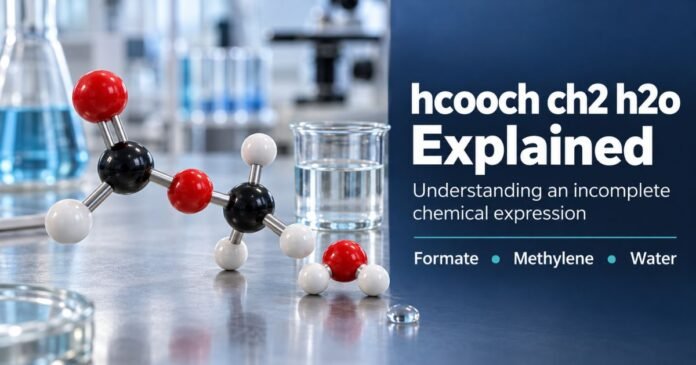

Imagine finding HCOOCH CH2 H2O in handwritten chemistry notes. Most of it looks familiar, so it is tempting to search for a compound with that exact formula. The trouble is that the expression is probably incomplete. One missing subscript or reaction sign can change its meaning entirely.
HCOO is usually connected with formic acid and formate compounds. CH₂ often appears as part of a carbon chain, while H₂O is water. These pieces make sense individually, but their connection is not shown. They could belong to one molecule, or water might be a separate reactant.
This does not mean that the expression is meaningless. It simply needs to be read with care. Looking at its separate parts can reveal what the original writer may have intended without giving the formula a false identity.
Why the Expression Causes Confusion
The spacing is the first problem. A chemical equation normally uses plus signs to separate reactants and an arrow to show the products. Here, there are only blank spaces.
The second problem is HCOOCH. Its final carbon does not appear to have all four bonds that carbon usually forms. Another atom, group or subscript is probably missing. Until that detail is restored, the complete structure cannot be drawn accurately.
Reading the Formula Piece by Piece
HCOO is known as a formate group. It comes from formic acid, written as HCOOH. Formate groups occur in salts and esters, so the opening part suggests that the intended substance may be an organic compound.
CH₂ contains one carbon atom and two hydrogen atoms. Within a larger molecule, it is called a methylene group. It normally joins other parts of a structure rather than standing alone.
H₂O is the only complete and certain part. It may act as a solvent, participate in a reaction or appear among the products.
Was Methyl Formate Intended?
A simple explanation is that HCOOCH was supposed to be HCOOCH₃. That small number changes the incomplete section into methyl formate, a known ester.
Methyl formate is formed from formic acid and methanol. It is a colourless liquid that evaporates readily and is flammable. In chemistry, it is useful for studying ester formation and breakdown.
This is a sensible interpretation, but not the only one. The separate CH₂ could belong to a longer carbon chain that was copied incorrectly. The original page or image would be needed to settle the matter.
Where Water May Fit Into the Reaction
If methyl formate and water were intended, water could break the ester apart through hydrolysis. The reaction would be:
HCOOCH₃ + H₂O → HCOOH + CH₃OH
The two products are formic acid and methanol. The equation also shows why writing the small numbers correctly matters: every carbon, hydrogen and oxygen atom must be accounted for on both sides.
Mixing the ester with water does not always produce a fast reaction. Acid, alkali or heat may be used to help the process. The conditions influence both the speed of the reaction and the amount of product formed.
What Can Be Concluded Safely?
The expression HCOOCH CH2 H2O should not be treated as the accepted formula of one chemical. It is better understood as an incomplete piece of notation containing formate-related material, a possible methylene group and water.
The most useful next step is to examine the original source. Look for a missing 3 after CH, a plus sign before H₂O or additional atoms connected to CH₂. Once the correct notation is available, the compound’s name, structure and reaction can be explained without guesswork.
Frequently Asked Questions
Is hcooch ch2 h2o a valid molecular formula?
Not in its current form. Important subscripts, bonds or reaction signs appear to be missing.
What is the HCOO part?
HCOO generally represents the formate group found in compounds related to formic acid.
What does CH₂ represent?
CH₂ usually represents a methylene group forming part of a larger organic structure.
Can the expression mean methyl formate and water?
It may, particularly if HCOOCH was intended to be HCOOCH₃, but the original notation must be checked.
What happens when methyl formate reacts with water?
Through hydrolysis, methyl formate can produce formic acid and methanol.