
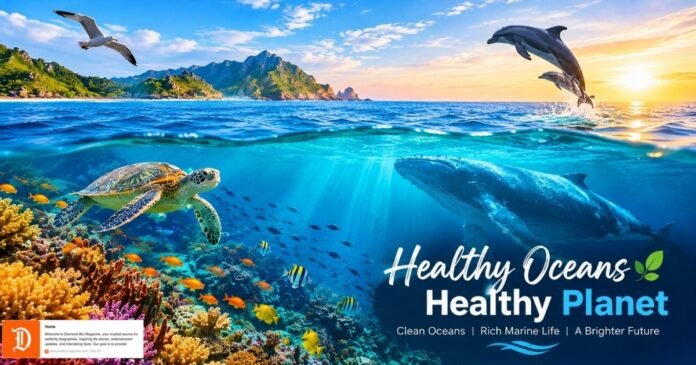

The ocean is one of the most powerful and fascinating aspects of Earth since it occupies a major portion of the planet and links together the various continents. It provides a great variety of wildlife and has an effect on nearly every part of the environment. Below the surface there are colorful coral reefs, extensive open waters, underwater mountains, deep trenches and ecosystems which are still being studied.
The ocean is not only beautiful and immense, since it helps to regulate global temperatures by absorbing and redistributing heat, has an essential role in the water cycle, and contains a great variety of life, ranging from microscopic plankton to large whales. Moreover, coastal areas depend on favourable seas for food, employment, transport and tourism.
At the same time, marine environments are facing growing pressure. Damage to delicate ecosystems can result from plastic pollution, rising temperatures, overfishing, habitat loss and other human activities. People will come to realise the importance of protecting marine environments for the future if they understand the ocean and its natural systems and the role it has in everyday life.
The Ocean and Its Place in the Earth
The Earth is frequently referred to as the blue planet since approximately 71 percent of its surface is made up of water, most of which is held in the interconnected global ocean and this ocean is usually divided into five major parts: the Pacific, Atlantic, Indian, Southern, and Arctic.
The various areas differ in terms of their temperature, depth, currents, and ecosystems yet are linked. Water keeps flowing between them through the action of ocean currents, tides, winds, and other natural processes.
The Pacific is the largest and deepest of the five oceans; the Atlantic is significant for major shipping routes and for the climate; the Indian Ocean has a great influence on the weather in the areas surrounding it; the Southern Ocean circles Antarctica and the Arctic Ocean is in the area around the North Pole.
In fact the seafloor is much more complicated than it appears from the surface, with underwater mountain chains, plains, valleys, volcanoes, and deep trenches; the deepest parts of the Earth are located under the sea.
Marine Ecosystems and Ocean Life
One of the most remarkable aspects of the ocean is the great variety of life it holds. Marine ecosystems occur in the shallow coastal waters where sunlight reaches all the way down to the extremely dark and cold deep-sea regions.
Coral reefs are one of the most well-known of all marine habitats since they provide shelter and feeding grounds for a large number of species and are especially important in tropical regions. So too do mangrove forests, seagrass meadows, estuaries, and coastal wetlands offer habitat for wildlife and at the same time bring a variety of benefits to the local communities.
In the open ocean, away from the shore, there are fish, seabirds, turtles, sharks, whales, dolphins, and a large number of smaller organisms. Plankton, since they are tiny creatures, form a vital foundation for many marine food chains.
Life also occurs in places which had previously seemed almost impossible for habitation. Organisms that are specialized manage to survive in the dark and under extreme conditions near deep-sea hydrothermal vents. As a result of these environments scientists have become aware of just how adaptable life can be.
How the Ocean Influences Climate and Weather
The ocean has a major role in the regulation of the Earth’s climate because water is able to absorb, store, and transport large quantities of heat, after which the ocean currents carry this heat all over the world and thus affect the temperatures in remote areas.
The climate and weather in coastal regions can be influenced by both warm and cold currents, and at the same time the movement of seawater interacts with the atmosphere leading to a constant exchange of heat, moisture, and gases.
The ocean is closely linked to the global water cycle because water evaporates from its surface, enters the atmosphere, forms clouds and then returns to Earth as precipitation. This process supplies freshwater to ecosystems and to communities all over the world.
The sea also absorbs a large amount of the carbon dioxide which enters the atmosphere. Even though this helps to reduce the quantity of carbon dioxide that is accumulating in the atmosphere, it does result in changes in the chemistry of sea water known as ocean acidification, and this in turn can affect organisms that form shells or skeletons from calcium carbonate.
Human Dependence on the Ocean
For thousands of years people have earned a living by using the ocean for food, for travel, for trade and for their means of livelihood, and its economic and social importance is still huge today.
Fishing provides food and brings in money for communities all over the world; coastal areas also support tourism, recreation, shipping, ports, and a number of other industries. Maritime transport forms a major part of international trade because it carries large amounts of goods between countries.
The ocean also has scientific and educational value since researchers study marine environments in order to gain a better understanding of climate, biodiversity, geology and the history of Earth; new discoveries keep on showing how much still remains unknown below the surface.
Coastal areas can also benefit from natural ecosystems since mangroves, wetlands, coral reefs, and other habitats not only provide important coastal protection but also support fish and other wildlife.
Threats Facing Marine Environments
The ocean, even though the scale of it is massive, is not free from the effects of human activity. A very obvious issue is pollution, for plastic waste, chemicals, oil, sewage and other pollutants can enter marine environments through rivers, coastal areas, shipping and other methods.
At present, climate change presents a major challenge since the increasing temperature of the oceans leads to coral reefs bleaching and other ecological changes take place. Additionally, the melting of ice on land also results in a rise in sea level, which has an impact on many coastal areas and ecosystems.
Overfishing can cause stress in fish populations and disturb the marine food webs, while the destruction of coastal habitats can likewise lead to a reduction in biodiversity and less natural protection against storms and erosion.
For the purpose of conserving the marine environment it is necessary to have better management, carry out more scientific research, fish in a responsible manner, cause less pollution, conserve habitats and promote international cooperation, as well as for general conservation efforts individuals can make a difference by reducing their use of unnecessary plastic and by responsibly getting rid of waste.
Why Protecting the Ocean Matters
A healthy ocean is closely linked to a healthy planet because marine ecosystems support wildlife, have an effect on the climate, contribute to the economy, and provide people with the resources on which they depend every day.
It’s not merely a matter of preserving beautiful coastlines or rare animals since protecting such environments also includes maintaining ecological systems which give benefits to both present and future generations.
Conservation measures can include the establishment of protected marine areas, the restoration of damaged habitats, improved fisheries management, less pollution, and providing support for research. Everyone has a role to play, whether or not they are governments, businesses, scientists, communities or individuals.
The challenges are great, but it is essential to start by gaining an understanding of marine environments; the more people learn about the sea and the way it is linked to life on land, the greater will be our ability to appreciate the need for responsible stewardship.
Conclusion
The ocean is not just a vast area of salt water; it is a complex living system that supports biodiversity, has an effect on the climate, drives the water cycle, and provides people all over the world with food, transportation, employment and other benefits.
Ours is closely tied to theirs; if we are able to protect marine ecosystems from pollution, overexploitation, habitat destruction and the effects of climate change, then we will be able to preserve these important environments for the future generations.
Also read: TikcoTech: A Practical Technology Blog for Smarter Phone Use
FAQs
What is the ocean worth?
The ocean is a vast area of salt water which covers about 71 percent of the Earth’s surface and contains a range of ecosystems as well as having a major influence on the planet’s climate and water cycle.
What is the number of oceans?
The world’s ocean is generally divided into five named sections: the Pacific, Atlantic, Indian, Southern, and Arctic Oceans.
What is the ocean’s importance?
The ocean supports marine life, helps in the regulation of the climate, is involved in the water cycle, provides food and jobs, and also contributes to transportation, tourism and other human activities.
What does the ocean contain?
The marine environment is home to a huge diversity of organisms, including plankton, fish, corals, sea turtles, sharks, dolphins, whales, seabirds, and a large number of microorganisms.
What are the primary hazards to the ocean?
The main dangers are pollution, climate change, overfishing, habitat destruction, warmer waters, and changes in the chemistry of the ocean.
How does the ocean affect the climate?
It absorbs and stores heat and then transfers this heat through currents, as a result of which global temperatures, weather patterns, and climate conditions are affected.