

Some musicians become famous through records. Others become part of a city’s memory through the shows they play and the people they meet along the way. Raven Slaughter belongs to the second group. A guitarist and singer in Northeast Ohio, he spent years performing for local audiences without becoming a mainstream name.
His music crossed hard rock, punk and metal during the 1970s and 1980s. He released a single in 1979, but his career was built largely onstage. Fellow musicians also remember him as someone who encouraged other players and remained connected to Cleveland’s music community.
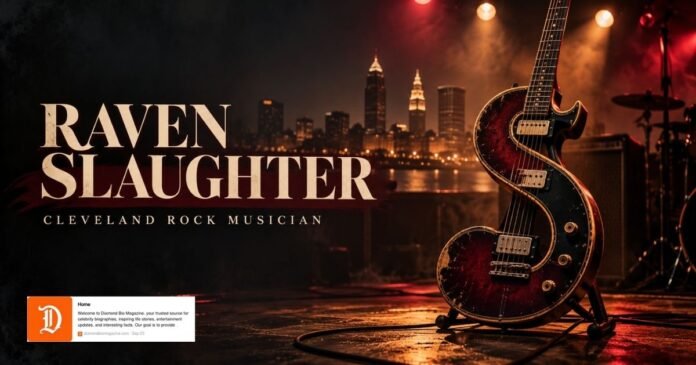
Today, many people first discover Slaughter through a guitar he reshaped himself. Frustrated with the Gibson instrument, he cut its body into an S shape and went on playing it for years. The unusual guitar later found a place on display at the Rock & Roll Hall of Fame in Cleveland.
It’s an eye-catching object, but it’s only the start of the story. Behind it is a working musician whose shows, friendships and unmistakable sense of character helped define a corner of Cleveland rock.
Raven Slaughter’s Place in Cleveland Rock
Slaughter came up in a music scene that valued live performance. Clubs gave bands room to build an audience, try out songs and get to know other players. For musicians working outside the national spotlight, those connections could last longer than a brief moment of publicity.
Through the 1970s and 1980s, Slaughter performed around Northeast Ohio and the Midwest. His music didn’t sit comfortably in a single genre. It drew from the force of hard rock while moving near the sounds of punk and metal. That made him a distinctive figure in a scene full of bands finding their own ways to play.
A local reputation grows one show at a time. Audiences remember the sound in a room, the look of a performer and the people they went with. Other musicians remember who shared a stage with them or gave them a chance to play. Slaughter’s place in Cleveland music comes from those experiences as well as the recordings he left behind.
His influence can be seen in the paths of musicians who worked with him. Guitarist Paul Michael, for example, played with Slaughter before leaving to form another Cleveland-area band, the Adults. The two groups had their own sounds, but that connection shows how closely linked local music careers could be.
The 1979 Single and His Years on Stage
In 1979, Slaughter released a single featuring “Headed for the Top” and “I Know Where I’m Coming From.” It remains a useful starting point for anyone curious about his music. The record captures part of a career that was otherwise shaped mostly by live appearances.
One single, though, cannot tell the full story of a musician who kept performing for years. Slaughter took his guitar to venues across the region, playing for crowds who knew him from the local circuit. His work continued well beyond the period represented by that 1979 release.
That distinction matters when looking back at Cleveland rock history. The artists with the biggest catalogues are often the easiest to find today. Regular club performers may have left fewer recordings, even though they were familiar faces to audiences at the time.
Slaughter also became known for supporting other musicians. That role rarely appears in a discography, but it can have a lasting effect on a music community. A recommendation, an introduction or a chance to join a band can change another player’s direction. His story includes those personal connections alongside his own performances.
The Gibson Guitar He Turned Into an S
Of all the things associated with Slaughter, his S-shaped electric guitar stands out most. It began as a Gibson instrument, but he grew frustrated because it kept going out of tune. He decided to cut the body into a new shape. The result looked as though it had been made to represent his surname, though Slaughter said that was not why he changed it.
The guitar’s history is sometimes described with different model names. Slaughter called it a Gibson Melody Maker in one interview, while other accounts have identified it as a Gibson Junior or Les Paul Junior. What is clear is that he altered the instrument himself and made the S-shaped guitar part of his performing life.
Its shape makes an immediate impression, yet the years of use give it meaning. This was a guitar he played, carried to shows and lived with through a long stretch of his career. Its display at the Rock & Roll Hall of Fame lets visitors see an object connected to Cleveland’s local stages.
A displayed guitar can also open a door to music that visitors might otherwise miss. Someone drawn in by its shape may leave knowing the name of a performer, a song from 1979 or a little more about the city’s club scene. That is a fitting role for an instrument made famous through live shows.
A Visit to the Rock Hall and a Lasting Local Story
In 2026, Slaughter visited the Rock & Roll Hall of Fame to see the guitar on display. He was receiving hospice care, and the trip gave him an opportunity to reconnect with an instrument he had played for many years.
There is a difference between holding a guitar onstage and seeing it behind a display. Slaughter expressed some desire to play it again, but he was pleased that other people could now see it. The visit brought fresh attention to his career and to the Cleveland musicians who had shared that world with him.
The guitar’s presence at the museum should not be confused with an induction into the Rock Hall. It is an artifact on display. Its value lies in the story it carries: a local player, a hand-altered instrument and decades of music made in front of live audiences.
For people searching for a Raven Slaughter Cleveland musician biography, public details about his early life are limited. The better-documented parts of his story are his performances, his 1979 record, his ties to other local players and the guitar that became his signature. Together, they show why a musician can hold an important place in a city’s history without becoming a household name.
Conclusion
Raven Slaughter, Cleveland musician and longtime performer, built his reputation through live music and relationships within the Northeast Ohio scene. His 1979 single preserves part of his sound, while the S-shaped guitar offers a visible reminder of the years he spent onstage. For anyone discovering him now, the most rewarding next step is to listen to the music and learn about the players who shared that scene.
(FAQs)
Who is Raven Slaughter?
Raven Slaughter is a guitarist and singer associated with Cleveland’s rock scene. He performed around Northeast Ohio and the Midwest, particularly during the 1970s and 1980s.
What music did Raven Slaughter play?
His music moved between hard rock, punk and metal. He was difficult to place in just one genre.
Did Raven Slaughter release any records?
Yes. In 1979, he released a single with the songs “Headed for the Top” and “I Know Where I’m Coming From.”
Why is Raven Slaughter’s guitar shaped like an S?
He cut the Gibson guitar into that shape after becoming frustrated with its tuning. Although people connected the S with his surname, he said that was not his reason for changing it.
Is Raven Slaughter’s guitar at the Rock & Roll Hall of Fame?
Yes. His S-shaped guitar has been displayed at the Rock & Roll Hall of Fame in Cleveland.
Was Raven Slaughter inducted into the Rock & Roll Hall of Fame?
The display of his guitar does not mean he was inducted as an artist. The instrument is part of the museum’s exhibits.